
The International Monetary Fund (IMF) has reduced India's growth forecast for FY27 to 6.4 per cent, citing the potential impact of higher energy prices offsetting the country's economic resilience. Despite this, India remains among the fastest-growing major economies.

The Asian Development Bank (ADB) has revised down India's GDP growth forecast for fiscal year 2026-27 (FY27) to 6.6 per cent from an earlier 6.9 per cent, primarily attributing the change to elevated energy prices stemming from the Middle East conflict. Despite this moderation, India is still expected to remain the world's fastest-growing major economy.

The IMF on Monday raised India's growth projection to 7.3 per cent for fiscal 2025-26, up 0.7 percentage point from its October forecast, on the back of better-than-expected performance of the economy. The Washington-headquartered multilateral lending agency has also revised India's Gross Domestic Product (GDP) growth forecast to 6.4 per cent for fiscal year 2026-27 beginning April 1, 2026, from its earlier estimate of 6.2 per cent.

The Reserve Bank of India (RBI) has introduced a new framework allowing banks to offer differential interest rates on bulk deposits based on their liquidity characteristics under the Liquidity Coverage Ratio (LCR) framework, while maintaining the principle of uniform pricing across similar deposits.

The IMF on Tuesday projected a growth rate of 6.1 per cent for India in 2023, which is a 0.2 percentage point upward revision compared with the April projection. This is reflective of the "momentum" from stronger-than-expected growth in the fourth quarter of 2022 as a result of stronger domestic investment, the International Monetary Fund (IMF) said. "Growth in India is projected at 6.1 per cent in 2023, a 0.2 percentage point upward revision compared with the April projection," it said in its latest update of the World Economic Outlook.

The best way for India to prepare is by preserving and strengthening the RBI's hard-won credibility, point out Rajeswari Sengupta and Vaishali Garga.
Fitch Ratings on Wednesday raised India's GDP growth forecast to 6.9 per cent for current fiscal year, from 6.5 per cent earlier, citing strong June quarter growth and domestic consumption-led demand.

The operator's liability in the case of an incident is limited to 3,000 crore for reactors with thermal power above 3,600 Megawatt; 1,500 crore for reactors with thermal power between 1,500 Mw and 3,600 Mw; 750 crore for reactors with thermal power between 750 Mw and 1,500 Mw; 300 crore for reactors with thermal power between 150 Mw and 750 Mw; and 100 crore for reactors having thermal power up to 150 Mw, fuel cycle facilities other than spent fuel reprocessing plants and transportation of nuclear materials.

India's new national accounts will leverage new data sources and surveys to enhance the measurement of the country's informal economy, and introduce double deflation methods across sectors, replacing the current system that relies on a single deflation mechanism in Gross Domestic Product (GDP) calculations.

India is projected to grow at 6.4 per cent in fiscal year 2025 and 2026, and the country's stable growth is driven by a reform momentum supporting robust consumption growth and a push for public investment, the International Monetary Fund has said. The IMF released its World Economic Outlook (WEO) Update on Tuesday.
India, the world's fourth largest economy, is set to maintain the 'goldilocks' phase with tailwinds of good growth, low inflation and robust banking performance as well as reform initiatives poised to sustain the economic pace witnessed during 2025.

Led by a sharper-than-expected deceleration in industrial activity, economic growth in India slowed more than anticipated and is projected to remain at 6.5 per cent till 2026, the International Monetary Fund said on Friday. "Growth in India slowed more than expected, led by a sharper-than-expected deceleration in industrial activity," the IMF said in its latest update of the World Economic Outlook, according to which the global economy is holding steady. In 2023, India's growth rate was 8.2 per cent, which dropped to 6.5 per cent in 2024.

Only bona fide victims would be compensated by banks within five days of receiving the complaint.

India registered its protest at the board of IMF, which met on Friday to review the EFF lending programme for Pakistan.

The Indian economy is projected to grow at 6.2 per cent in 2025-26, slower than earlier estimated rate of 6.5 per cent, due to escalated trade tensions and global uncertainty, the International Monetary Fund (IMF) said on Tuesday. "For India, the growth outlook is relatively more stable at 6.2 per cent in 2025, supported by private consumption, particularly in rural areas," IMF said in its World Economic Outlook (WEO).

India's GDP growth is likely to moderate from 8.2 per cent in 2023 to 7 per cent in 2024 and 6.5 per cent in 2025 because the pent-up demand accumulated during Covid has exhausted, as the economy reconnects with its potential, the International Monetary Fund (IMF) said on Tuesday. About the global economy, the IMF said the battle against inflation has largely been won, even though price pressures persist in some countries.

The answer is to be found in the rise of the global south and in particular, the rise of China, explains Aakar Patel.

The Reserve Bank of India's (RBI's) state of the economy report observed that any durable alignment of headline retail inflation with the target of 4 per cent could recommence in the second half of FY25 and sustain until numbers closer to the target are seen during the course of FY26, dashing hopes of any reduction in the policy repo rate in the current financial year. The report, authored by RBI staffers, including Deputy Governor in charge of monetary policy Michael Patra, said though headline numbers may fall in July and August due to base effect, it is likely to reverse in September.

Revising its economic outlook, International Monetary Fund (IMF) today marginally brought down India's growth rate projections to 5.6 per cent for this fiscal and 6.3 per cent for the next financial year.

If India can fast utilise currency flows for long-term projects, the regulatory regime could be more liberal.

Donald Trump's tariffs, meant as political punishment, have avoided the predicted chaos, lifting US growth, weakening rivals, and letting him claim victory in a resilient global economy, observes T T Ram Mohan.

The government's initiative to migrate SEZ data from NSDL software to ICEGATE system for streamlined reporting of import data caused double counting of gold imports, resulting in inflated figures and the issue has now been largely rectified, government sources said. The downward revision has provided the actual picture of trade deficit (difference between imports and exports), which was earlier looking very high. The deficit for November will now be revised downwards from $37.84 billion to about $32.8 billion. Similarly, there will be a revision in overall import numbers as well.
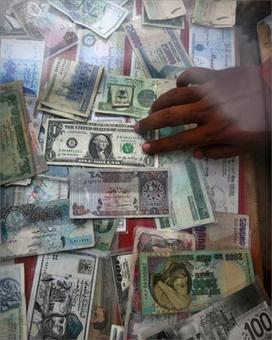
The International Monetary Fund on Wednesday raised India's growth forecast to 5.4 per cent for 2009 and said that the global economy is beginning to pull out of a recession.

Deloitte India on Friday said it estimates India's GDP growth at 6.6 per cent in the current fiscal helped by consumption expenditure, exports rebound and capital flows. In its India's economic outlook report, Deloitte said the rapid growth of the middle-income class has led to rising purchasing power and even created demand for premium luxury products and services. With the expectation that the number of middle-to-high-income segments will be one in two households by 2030/31, up from one in four currently, we believe this trend will likely become further amplified, driving overall private consumer expenditure growth, it said.
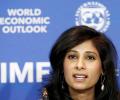
The IMF on Tuesday cut India's economic growth forecast by 0.5 percentage points to 9 per cent for the current fiscal year, with its chief economist Gita Gopinath saying that the slight downgrade is mainly due to the impact of the spread of the Omicron variant. "If you look at the 2021-22 fiscal year, we have a slight downgrade of -0.5 percentage points and for the next fiscal year 2022-23 we have a slight upgrade of 0.5 percentage points. So, growth for the previous fiscal year is now nine per cent and for this year now is at nine per cent. We moved it up slightly," Gopinath told reporters during a news conference in Washington. In its latest update of World Economic Outlook on Tuesday, the International Monetary Fund has cut India's economic growth forecast to 9 per cent for the current fiscal year ending March 31, joining a host of agencies which have downgraded their projections on concerns over the impact of the spread of Omicron on business activity and mobility.
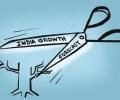
The International Monetary Fund (IMF) on Tuesday lowered India's economic growth projection for the current fiscal to 5.9 per cent from 6.1 per cent earlier. Yet India will continue to be the fastest-growing economy in the world. In its annual World Economic Outlook, IMF also lowered the forecast for 2024-25 fiscal (April 2024 to March 2025) to 6.3 per cent from the 6.8 per cent it had predicted in January this year. The growth rate of 5.9 per cent in the 2023-24 fiscal compares to an estimated 6.8 per cent in the previous year.

It will be the second Budget of the Modi 3.0 government and eighth straight Budget for Nirmala Sitharaman, rare in Indian polity.

Borrowers should consider switching from an MCLR-linked to a repo rate-linked loan.

The International Monetary Fund (IMF) on Tuesday slashed India's growth forecast for 2022-23 (FY23) by 80 basis points to 7.4 per cent, citing less favourable external conditions and rapid policy tightening by the central bank. In its update to the April World Economic Outlook, the IMF said that though a global recession in 2022 was ruled out with a growth estimate of 3.2 per cent, the balance of risks was squarely to the downside, driven by a wide range of factors that could adversely affect the global economic performance. "The risk of recession is particularly prominent in 2023, when in several economies growth is expected to bottom out, household savings accumulated during the pandemic will have declined, and even small shocks could cause economies to stall.
While the Reserve Bank and the Economic Survey of the finance ministry have projected India to grow at 6.9 per cent and 6.5 per cent in current fiscal, the International Monetary Fund estimates it to be 6.6 per cent.

'India has the potential to grow at more than 7%, with the monetary policy providing a supportive hand.'

Government is also will also enter into an agreement with Japan for a $50 billion swap.

The downgraded World Bank forecast follows a similar move by the International Monetary Fund, which cut its growth forecasts two months ago

Indian economy is expected to grow by 10 per cent or more in the current fiscal, and 8 per cent plus in the next fiscal year, Niti Aayog Vice-Chairman Rajiv Kumar said on Tuesday. Addressing a book launch event, Kumar further said that seven years of the Modi government has laid a strong economic foundation for businesses to thrive in India. "There was a hiccup (in economic growth) for two years due to COVID-19 pandemic.

International Monetary Fund Chief Economist Gita Gopinath tells Indivjal Dhasmana high-frequency indicators for the third quarter of 2021 indicate momentum in economic recovery in India.

Shigeru Ishiba is expected to prioritise strengthening Japan's military capabilities and fostering deeper international partnerships, particularly with India, with whom Japan shares significant strategic interests, explains Dr Rajaram Panda.
The economy may grow by around 7 per cent this financial year as estimated by the Monetary Policy Committee (MPC) of the Reserve Bank of India (RBI), say economists with various organisations. The first advance estimates for 2023-24 will be released on Friday by the National Statistical Organisation (NSO), an exercise done for calculating ratios such as the fiscal deficit. The interim Budget will be presented on February 1.

The IMF said global growth is projected to reach 3.9 per cent in 2018 and 2019, in line with the forecast of the April 2018 WEO, but the expansion is becoming less even, and risks to the outlook are mounting.

One could argue that India is not troubled in the same way as China is by a declining population and structural problems in real estate/construction and finance. But India has serious trade and fiscal imbalances, and excessive dependence on capital expenditure by the government, points out T N Ninan.
